How to Design an Efficient Enamel Coating System for Modern Manufacturing
A comprehensive technical guide to optimizing porcelain enamel production for high-performance industrial and consumer applications.
Introduction to Advanced Enameling Technology
In the landscape of modern material science, the durability and aesthetic appeal of surfaces are paramount. The implementation of a sophisticated enamel coating system has become a cornerstone for industries ranging from household appliances to architectural cladding. Porcelain enamel, a glass-like inorganic coating fused to metal at extreme temperatures, offers unparalleled resistance to corrosion, chemical degradation, and thermal shock. As manufacturing requirements evolve towards higher throughput and lower environmental impact, designing an efficient production line requires a deep integration of mechanical precision, chemical expertise, and digital intelligence.
An efficient enamel coating system is not merely a collection of individual machines; it is a synchronized ecosystem designed to transform raw steel into high-value components. Whether you are producing oven interiors, water heater tanks, or building facades, the objective remains the same: achieving a flawless finish with maximum material utilization and minimum energy consumption. This guide explores the critical phases of system design, the technological innovations driving the industry, and how strategic automation can redefine your production capabilities.
Critical Components of an Enamel Coating System
1. Precision Surface Pre-treatment
The foundation of any successful enameling process lies in the quality of the substrate preparation. Without a chemically and physically clean surface, even the most advanced enamel coating system will fail to achieve proper adhesion (ASTM D3359). For steel plates and tanks, pre-treatment typically involves a combination of mechanical grit blasting and multi-stage chemical washing. Grit blasting creates a microscopic roughness that facilitates mechanical interlocking between the glass frit and the metal.
In high-volume lines, automatic spray pre-treatment systems utilize alkaline degreasing, acid pickling, and neutralization cycles. Modern systems now incorporate real-time monitoring of bath concentrations and temperatures to ensure consistency. For architectural panels and water heater tanks, the use of nickel flashing or cobalt-rich ground coats in the pre-treatment phase ensures that the subsequent enamel layer forms a permanent chemical bond with the iron, preventing fish-scaling and delamination.
2. Advanced Coating Application Methods
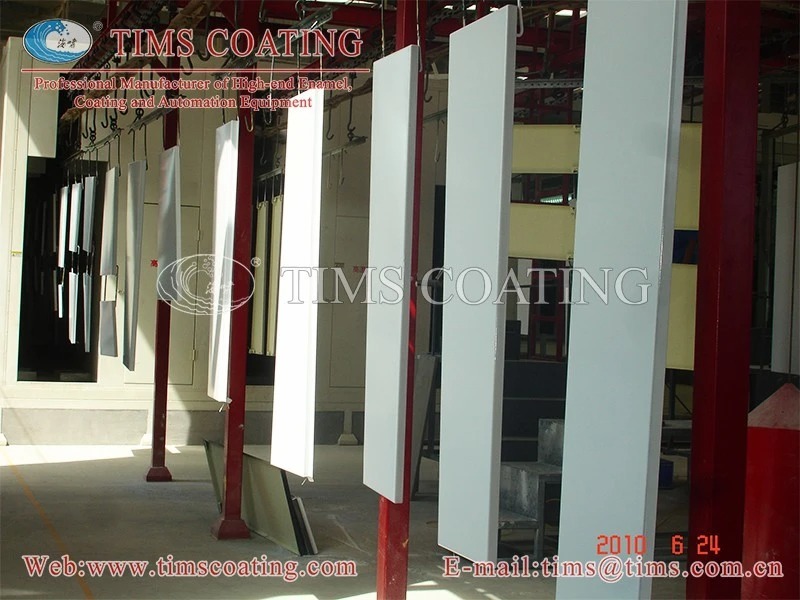
The application phase is where efficiency is most visible. Manufacturers must choose between wet enamel slurry application and electrostatic dry powder spraying. An automated enamel coating system utilizing electrostatic technology is often preferred for flat or simple cylindrical shapes due to its high material utilization rates, which can reach up to 95%. This process involves charging enamel powder particles which are then attracted to the grounded workpiece, ensuring uniform coverage even on complex edges.
For complex geometries like the interior of heat pump water heater tanks, wet enameling remains a vital solution. Wet application allows for full immersion or flow coating, ensuring that internal welds and hard-to-reach corners are protected. Integrating AI-powered thickness control within this stage allows the system to adjust spray parameters in real-time, maintaining a strict coating range of 0.2mm to 1.5mm. This precision reduces waste and ensures that every piece meets the rigorous ISO 12944 standards for surface protection.
Thermal Processing and Energy Optimization
The firing process is the most energy-intensive part of the enamel coating system. At temperatures between 850°C and 900°C, the glass frit melts and fuses with the metal. Designing an efficient furnace involves more than just reaching the target temperature; it requires extreme thermal uniformity (±5°C) and advanced energy recovery. High-performance gas-fired curing ovens now feature radiant tube heating and IoT-enabled energy management to minimize natural gas consumption.
To maximize ROI, modern lines utilize waste heat recovery systems. By capturing the exhaust heat from the furnace and redirecting it to the drying ovens or pre-treatment tanks, manufacturers can reduce their overall energy footprint by 20% or more. Furthermore, the use of high-temperature nano-insulation materials in the furnace walls ensures that the exterior remains cool while the interior maintains the intense heat required for perfect glass-to-metal fusion. This balance of power and efficiency is what separates a standard line from a world-class production facility.
Throughput is another critical metric. Modular designs that support a continuous flow of 600–800 square meters per hour are becoming the industry standard. By utilizing heavy-duty overhead conveyors or "power and free" systems, the enamel coating system can handle massive workpieces—up to 3 meters in length—without interrupting the production cycle. This seamless integration between movement and processing is essential for maintaining high-volume output in sectors like the automotive and appliance industries.
The Benefits of a Fully Automated Enamel System
Superior Surface Durability
The resulting finish is fireproof, graffiti-resistant, and non-porous. It withstands temperatures up to 550°C and offers extreme resistance to UV fading and chemical corrosion, far surpassing liquid paint or standard powder coatings.
Operational Cost Reduction
Automation reduces labor requirements by up to 80%. With real-time defect detection via hyperspectral imaging, the "first-time-right" rate is significantly increased, eliminating the costs associated with rework and scrap.
Environmental Compliance
Our systems are designed to be eco-conscious, minimizing VOC emissions and implementing closed-loop water filtration. This ensures compliance with FDA, EN 10209, and ISO standards for sustainable manufacturing.
Production Versatility
A modular enamel coating system allows for rapid transitions between different product types—from small barbecue grills to large industrial panels—without extensive downtime for reconfiguration.
Why Choose TIMS for Your Enamel Solutions?
At TIMS, we have spent decades perfecting the art and science of industrial coating. Our expertise extends across a wide spectrum of technologies, allowing us to provide turnkey solutions that are precisely matched to our customers' unique requirements. We don't just sell equipment; we deliver integrated production systems that empower manufacturers to achieve new levels of efficiency and quality.
One of our flagship innovations is the ultra-flexible enamel coating system. This patented technology allows a single coating line to process multiple product models simultaneously, reducing the initial investment by over 50% for many of our clients. From high-performance enamel coating lines for steel plates to specialized enamel production lines for kitchen and BBQ appliances, TIMS is at the forefront of the industry.
Our systems are equipped with the latest smart technologies, including PLC central management and user-friendly HMI interfaces. This ensures that every parameter, from conveyor speed to curing temperature, is under total control. Whether you are looking for an automatic powder coating line or a complete electrophoresis production line, TIMS provides the reliability and technical support you need to succeed in a competitive global market.
Frequently Asked Questions
Q1: What are the primary benefits of investing in a modern enamel coating system?
A modern enamel coating system provides extreme durability, offering surfaces that are resistant to high temperatures, chemicals, and physical wear. It also ensures high material utilization and significantly lower labor costs through automation and real-time monitoring.
Q2: How does an automated enamel coating system improve product quality?
Through AI-powered thickness control and hyperspectral imaging for defect detection, the system ensures a consistent and flawless finish. This eliminates human error and ensures that every piece meets strict certification standards like FDA and ISO 12944.
Q3: Can an enamel coating system be customized for different workpiece sizes?
Yes. TIMS designs modular systems that can be tailored to fit specific factory layouts and workpiece dimensions. Our lines can handle steel plates up to 3m x 1.5m and can be configured for batch or continuous production cycles.
Q4: What is the energy efficiency of a gas-fired enamel coating system?
Modern systems are highly efficient. By incorporating IoT-enabled energy recovery and high-tech insulation, our furnaces can reduce natural gas consumption by up to 20% while maintaining thermal uniformity of ±5°C.
Q5: How does TIMS support the maintenance of an enamel coating system?
TIMS provides a full one-year system warranty and lifelong technical support. We offer spare parts supply and remote diagnostic services to ensure your production line continues to operate at peak efficiency with minimal downtime.
Conclusion
Designing an efficient enamel coating system is an investment in the future of your manufacturing quality and operational sustainability. By choosing a partner like TIMS, you gain access to cutting-edge technology, patented energy-saving solutions, and a global legacy of engineering excellence.